Friday, March 2, 2018

“BEAUTIFUL DEATH”


"Jesus called out with a loud voice, 'Father, into your hands I commit my spirit.' When he had said this, he breathed his last” Luke 23:46.

Death? Beautiful? At first glance you may be tempted or even yield to the temptation to ask: “Him lick him head, or what?”  What an insensitive adjective to place beside the word death! There is no denying that death is painful. The one who feels it knows it!! What is beautiful about death? Death is loss. Death is grief and misery. Death is ugly. Or is it? 

While Jesus hung on the cross he shouted (“loud voice”), as if he wanted everyone down through the ages to hear: 'Father, into your hands I commit my spirit.' These words were written by David and are found in Palm 31:5. Jesus would have learnt these words as a young child because they formed part of the evening prayer of every devout Jew. In these words we hear intimacy, trust, confidence and surrender. According to Dr. Luke, these were his final words before breathing his last.

Irrespective of who we are, there comes a moment in the life of every human when we breathe our last. We are confident that there is no certainty when and where this will happen. However, we have some control over the atmosphere surrounding our departure. 


The life of the roving evangelist, revivalist and co-founder of the Methodist Movement, Rev’d John Wesley, was slowly, but surely, ebbing away. For five days he grew weaker and weaker in body but stronger and stronger in faith. On March 2, 1791, 227 years ago, Wesley sang the Isaac Watts hymn: "I'll Praise My Maker While I've Breath".
The hymn says:
“I’ll praise my Maker while I’ve breath,
And when my voice is lost in death,
Praise shall employ my nobler pow’rs;
My days of praise shall ne’er be past,
While life and thought and being last,
Or immortality endures.”
It is reported that his very last words were "Best of all is, God
is with us." Then he breathed his last. That is truly a good way to breathe one’s last.

Death is painful, but it does not have to be ugly. We can decide whether to have a good ending or a bad ending. It is simple. However we spend our life, that is most likely how we will die.

If we spend our days disobeying God, tormenting creation, destroying lives with the jealousy of our hearts, lying, stealing, gossiping, betraying, being unjust and causing misery to others, we will most probably die an unpleasant and ugly death. On the contrary, if we commit our lives to Jesus and his mission and worship God, do good deeds, tend to the environment and animals, honour our parents, feed the hungry and support the orphan and the widow, it is more likely that we will have a beautiful end.

Thought:      Dressed and Ready for a “Beautiful Death”? 

Prayer Focus: Pray for faith, hope and confidence when it is
                     time to breath our last.

Friday, June 30, 2017

God made them all


“The voice said to him again, a second time, “What God has made clean, you must not call profane” Acts 10:15.
Acts 10 provides an account of the expansion of Christianity into Caesarea, the first city to have Gentile Christians and a non-Jewish church. God had eyes on Cornelius, a centurion in the Italian regiment, and a devoted, God-fearing, extremely generous and praying man. Peter was the point-man to undertake the task of evangelizing and counselling him. However, Peter had deep and abiding prejudices which had to be eradicated in order for him to become appropriately missional. He needed to see others as God saw them. God had to deal with his case.

Peter believed that Gentiles were inferior people who would not receive God’s favour and redemption. He did not believe a Gentile Roman soldier could accept Jesus. Then God gave Peter a vision.

In his vision he saw a wide variety of four-footed animals and reptiles of the earth, as well as birds of the air, and was instructed to “kill and eat!” According to Jewish law, certain foods were forbidden to be eaten (see Leviticus 11). Being a strict and faithful Jew with all his traditions, pride and prejudice, Peter was shocked, and promptly declared “No, Lord!…I have never eaten anything impure or unclean” (see Acts 10: 12-14). Can you feel the disdain, disgust and the utter rejection of the act and even the very revolting thought? However, God assured Peter that What God has made clean, you must not call profane.

The creation has ways and means of doing the unusual and unexpected, so we as humans must be careful not to allow our traditions and prejudices to so impair our judgment that we are unable to accept and embrace the unusual. This morning I was reminded of the Peter’s vision when a church member sent me an ackee from her tree. Now normally an ackee has three, and at most, four pods. This one had 13! Interestingly, the member and many of my WhatsApp friends said they would not eat this ackee.

God’s handiwork is all around us and we must never allow our traditions, expectations, pride and prejudices to prevent us from appreciating and enjoying what God is doing or has done, even if it seems strange or abnormal to us. If we are not careful, our traditions and prejudices can frustrate God’s work and condemn some of us to death and destruction.

Cecil F. Alexander wrote:

All things bright and beautiful,
All creatures great and small,
All things wise and wonderful:
The Lord God made them all.

The cold wind in the winter,
The pleasant summer sun,
The ripe fruits in the garden,
He made them every one.

Do you believe that?

Thought: With all the varieties in the world, there is but one Creator.
Prayer Focus: For deliverance from the negative forces of prejudice


Friday, June 9, 2017

Truly Amazing

You alone are the LORD. You made the heavens, even the highest heavens, and all their starry host, the earth and all that is on it, the seas and all that is in them. You give life to everything, and the multitudes of heaven worship you (Nehemiah 9:6).
This solemn declaration forms part of the worship experience during which the Israelites confessed their sins and the sins of their ancestors. The Levites asked that God’s name “be exalted above all blessing and praise” and went on to say, “You alone are the LORD…You give life to everything, and the multitudes of heaven worship you.” That was perfectly in order because God is awesome. God’s power and grace are beyond human comprehension. God is truly amazing!

When we use the word ‘amazing’, we refer to that which causes astonishment, great wonder, or surprise.  The longer I serve God and the more I depend on God, the more I realize how amazing God is, and that God “moves in mysterious ways”.

For weeks my phone was a source of frustration because often the battery would not charge. On Sunday, 30th April 2017, it refused to charge. Still hoping it would charge I took it to the office the next day. Guess what? No! It still refused to charge. There was no point in taking it home, so we parted company and slept in different locations. At about 4:30 p.m. the next day, I plugged it in and noticed that it began charging. With the almost endless sound of various messages coming in, I took it home. At home it continued charging. Could someone actually be calling me at 2:30 a.m. on Wednesday, 3rd May? Reluctantly, I arose and answered the phone. “Hello!” The immediately recognized voice said: “I missed my stop in Belgium and I am in Amsterdam.” “Where?” “Amsterdam,” said Heidi. Amsterdam and Belgium are two different places and far from each other. Two days later, the phone again refused to charge and I had to replace it. I still marvel at how events unfolded, and I am further convinced that God is truly amazing.

I asked myself what would have happened if my phone had not reacted positively to the attempt to charge it, and I had left it at the office for a second night. Of course there may be some technological explanation for the positive reaction, but for me there is also a theological explanation. I am reminded that God wants the best for everyone and that God is always moving in ways that we cannot comprehend, and which are often confusing, but are always in our best interests.

Oh! That night we woke up Heidi’s uncle who then called a cousin of hers who lives in England but who was on assignment in Amsterdam. Unknown to us, she was scheduled to return to England on the 3rd, but had postponed it until the 8th. She contacted Heidi and in less than 10 minutes, Heidi was at home. She lived a few minutes from the bus station. Who could it be but God?

Are you convinced that God is amazing? I am, and Deniece Williams is so convinced that she wrote:
God is truly amazing
My God is truly amazing
He is a friend in need, He is a problem solver
He is the strength that never lets you fall
He is your peace, faith is the key!


Thought: God moves in mysterious ways.
Prayer Focus: For faith to trust God with our affairs


Sunday, May 28, 2017

HIS WOUNDS THE PROOF

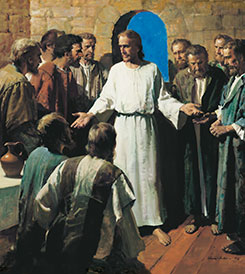
“When he had said this, he showed them his hands and feet. And while they still did not believe it because of joy and amazement, he asked them, “Do you have anything here to eat?” They gave him a piece of broiled fish, and he took it and ate it in their presence” Luke 24:40-43.

Luke tells us that after his resurrection, Jesus visited his disciples and they were “startled and frightened, thinking they saw a ghost” (Luke 24:37). Jesus asked them why they were so frightened and disturbed. He sought to convince them that it was he standing amongst them. They simply could not believe their eyes, minds and hearts. Jesus then offered them the proof, the hard evidence, that the person standing in front of them was he, Jesus of Nazareth, who had been crucified. To aid in convincing them, Jesus showed them “my hands and my feet” and invited them to touch him and see that he had “flesh and bones” (v.39). His hands and feet bore the wounds that were the hard evidence.

Those wounds!!! Those were wounds of compassion, grace, sacrifice and self-emptying love. They were the hard evidence of his humanity and God’s everlasting and unconditional love for the world. He showed them his wounds to inspire them, satisfy their curiosity, calm their fears and anxieties, and empower them.

All across the world there are Christians bearing the wounds of their love and loyalty to Jesus. Those who love and serve the Lord will have wounds inflicted on them that can serve as the hard evidence of their love and commitment to Christ. Jesus told his disciples that following him meant being willing to carry a cross. Bearing the cross involves wounds.

That wound might be the victimization one faces in the workplace because of a principled stand, or ostracism because of one’s unwillingness to participate in corruption, or the rejection of family members because of the decision to become a follower of Jesus, or imprisonment for sharing the faith, or being ridiculed for being a Christian or even the choice to answer “yes” to the call to full-time ministry. Some wounds might be physical, psychological or material.

In a real way, our wounds reveal our humanity, our weaknesses, our brokenness and our victory. Jesus’ wounds were signs that the will of God was done on earth as it was in heaven. In the process of experiencing his wounds, he declared: “It is finished!” The work was accomplished and the wounds had been inflicted. Matthew Bridges was correct when he wrote:

Crown him the Lord of love,
behold his hands and side,
those wounds, yet visible above,
in beauty glorified.

When you are tempted to try to hide the wounds or weaknesses which are ultimate proof of our humanity, and also our love for God and commitment to the work of God’s Kingdom, remember Jesus’ willingness to show the hard evidence.

Thought: What are your wounds for your love of Jesus?
Prayer Focus: Pray for those who are being “wounded” for Christ’s Sake.

Monday, May 22, 2017

FOR GOD'S SAKE

“But when she could hide him no longer, she got a papyrus basket for him and coated it with tar and pitch. Then she placed the child in it and put it among the reeds along the bank of the Nile” Exodus 2:3
The Egyptian Pharaoh who “knew not Joseph” was becoming increasingly uncomfortable with the growth and influence of the Hebrew population in Egypt. Besides enslaving them, the Pharaoh had instructed the midwives to participate in a covert state programme of systematic and surgical infanticide. It was surgical in that only the boy babies were to be intentionally killed at birth. Girls were to be allowed to live (see. Exod. 1:16). The success of this programme was being thwarted and undermined by the agents of the state (see Exod. 1.17). A new scheme was devised which required the participation of the entire Egyptian population and not just the midwives. The instruction to the Egyptians was that: “Every Hebrew boy that is born you must throw into the Nile, but let every girl live” (Exod. 1:22).

When Jochebed gave birth to a promising baby boy, she hid him in her house until it was no longer safe to do so. Exod. 2 tells us that “she got a papyrus basket for him and coated it with tar and pitch. Then she placed the child in it and put it among the reeds along the bank of the Nile”. The same Nile! Pharaoh’s daughter, offspring of that very Pharaoh, went by the river to bathe and happened upon the child. The brilliant thinking of Miriam, the boy’s big sister, resulted in Jochebed being employed and paid to nurse and care for her son. When the child was old enough, he was taken to the Egyptian Palace and named Moses.

In Pharaoh’s hand, and according to his evil and malicious will and intention, the River Nile should have been the watery grave of baby Moses. However, in God’s hand, and according to the purpose and will of God, the River Nile comprised the waters from which Moses would sail into the Pharaoh’s Palace and become an instrument for the liberation of Israel and the formation of a nation state.

What can we learn from this story? It seems to me that one of the inspiring lessons that we can glean from this, is that for the sake of the work and the glory of God, an instrument of death and destruction can become the source of life and hope. 

Some years ago, a student was converted from Islam to Christianity. On returning home, he informed his parents, and they were both furious and disappointed, but he held firmly to his new-found faith. A couple days later, as they all gathered for the evening meal, they began to partake of their soup. The young man brought his cup to his mouth to start drinking, but the vessel slipped from his hands, and the soup spilt all over the floor. As he cleaned up the chair and floor, the cat started licking up the soup. Alas! A few minutes after, the cat died. That same afternoon, the entire family made a decision to accept and serve Christ. The instrument of death, for God’s sake, had become an inspiration for life.

God’s will and purpose is supreme.

Thought: We never know what is up God’s sleeves!
Prayer Focus: For the transformation of the schemes of death and destruction into experiences of life and hope

Wednesday, April 26, 2017

The Hope of the Empty Tomb

“But the angel said to the women, “Do not be afraid; I know that you are looking for Jesus who was crucified. He is not here; for he has been raised, as he said. Come, see the place where he lay” Matthew 28: 5-6.
The tomb from which Jesus rose was empty of his body but filled with hope that can transform our lives and circumstances.

The Jewish leaders wanted Jesus dead. They paid Judas to betray him; inveigled and manipulated the crowds to demand his crucifixion; and placed guards at the grave to ensure no one removed his body. However, when the women arrived at the tomb the stone was rolled away and Jesus’ body was not there. Physically the tomb was empty but from a spiritual perspective, it was full.

Generally, we associate “empty” with negativity. We speak derogatorily when we say “empty promises” or “empty head”. However, emptiness can signify success, achievement, hope and promise. An empty prison means the prisoners are free; an empty nest means the birds have grown and flown away; an empty hospital bed could mean the sick person is well enough to be discharged.

The resurrection of Jesus is victory over death and the grave, and an affirmation that nothing is impossible for God. Easter is about overcoming the grimness of the grave and hopelessness of life. The “empty” tomb signified for Jesus and the entire human race, a tomb “filled” with power, hope, and freedom from death. It continues to inspire the hope of forgiveness in broken relationships; peace in a broken world; assurance in the midst of doubt; success in the heart of failure and heaven in the face of death. This hope is centered in the person of Jesus Christ (see Psalm 39.7 and Psalm 71.5).

The crucifixion and death of Jesus drove his followers into a downward spiral of hopelessness. The men going to Emmaus told the person who joined them that they had hoped that Jesus was the one who was going to redeem Israel” Luke 24:21. The empty tomb added to their sense of hopelessness. Mary was so overwhelmed with grief and hopelessness that she began crying (see John 20: 13-15).

The spirit of hopelessness constantly threatens to overwhelm us. Contemplating the many difficulties we face as individuals, church and country often leads to the temptation to give up, throw in the towel and believe that there is no possibility of seeing any light at the end of the tunnel.

Easter is a powerful reminder that the Tomb is Empty because the awesome and creative power of God is able to do more than we can ask or think. God can bring light out of darkness, and hope out of despair. God is not asking us to become the eternal optimist but to be a “prisoner of hope”.

We do not have to settle for things the way they are, or surrender to despair. God is always working on our behalf to bring life out of death.

Thought: God’s most distinctive attribute is the ability to make something new. Think about that!

Prayer Focus: For those who have lost, or are losing hope

Wednesday, March 29, 2017

DIFFERENTLY ABLE

“As he went along, he saw a man blind from birth” John 9:1.

A blind man was walking with his cane when someone bumped into him. The blind man swung his cane and asked: “Why you don’t look where you going?”

The controversy associated with the healing of the man born blind, and his eventual excommunication from the Synagogue, as opposed to his receiving shouts of “hallelujah”, is one of the most captivating narratives in the gospels. This gripping, but painfully real story depicts the enduring struggle within the community of faith between those whose eyes are open to new ideas and experiences of God and those who eyes remain closed to what God is doing. There is also the demonstration of God’s love for those who are “differently able”.

This incident may have occurred in the precincts of the Temple, where beggars habitually gathered. Rather than supporting the view that this man’s impairment was linked to sin, however, Jesus said it provided an opportunity to demonstrate God’s love and work.

This narrative points to the fact that every human being, irrespective of abilities or disabilities, is a subject of God’s love and a recipient of God’s grace (v.3). Also, one must never be too busy to make time for those who are differently able (v. 1). Also, we must seize the opportunities, and do what needs to be done, whenever the occasion presents itself. Jesus said: “As long as it is day, we must do the works of him who sent me. Night is coming, when no one can work” (vv.4-5).

Many among us are differently able, but we are all members of the human family, and every able-bodied individual must do whatever is requisite and necessary to enhance the well-being and welfare of those who are differently able. This does not necessarily mean giving persons cash or kind. Sometimes we just need to be there for others.

The Ministry of Presence, even for the differently able, can be redemptive and reassuring. While playing in a friendly football match in Germany in 1979, I was temporarily impaired after being struck in my eye by the ball. In pain, and unable to open my eye, I lay on my bed while my Irish team-mates and the young German people were having a barbecue downstairs. Sitting beside my bed, in absolute silence, was a young lady from Germany. She made time for me and just sat there.

Those who are differently able are 100% human. We must try desperately to avoid being the kind of people who “see and avoid”, like the priests and Levite on the Jericho Road, but instead, seek to be like the Samaritan who did not miss the opportunity to show love and respect. Steps should be taken to ensure that churches, schools, homes, offices and other business places facilitate the participation of everyone. Jesus cared, and still cares, for everyone, and so should we.

As Charles Wesley wrote:
“Help us to help each other Lord
Each other’s cross to bear.”

Thought : We are all different.
Prayer Focus For wisdom and courage to engage your abilities in support of those who are Differently Able

Friday, March 17, 2017

Amnesia of Grace

“But the people were thirsty for water there, and they grumbled against Moses. They said, “Why did you bring us up out of Egypt to make us and our children and livestock die of thirst?” Ex. 17:3

Were not these the same people who were slaves in Egypt? Were they not the people who witnessed their enemies perishing in the waters of the Yam Suph (Hebrew for Sea of Reeds), commonly called the Red Sea? Did they not experience the “bitter water made sweet” (Ex.15:22-27) and hungry multitudes being fed and miraculously sustained with elements from above (Ex.16)? These were the same people who experienced those gracious displays of God’s love and mighty power. Later, in the face of increasing anxieties and uncertainties, amnesia got a hold of them. They forgot the grace of God.

Grace is the undeserved favour of God. We have all experienced God’s favour that we did not deserve and could not earn. Let’s face it: we do not receive blessings and deliverances because we live righteous and sober lives, or because we have blundered on our journey through life. Unlike our fellow human beings, God sees us and knows us as we are, and also for who we will and can become. God does not treat us as our sins deserve, but looks at and beyond our faults. That’s grace!

This does not mean we must be presumptuous and prod happily along, doing as we please. No! God has standards that must be observed, one of which is to remember God’s graciousness. You and I are where we are today because of the grace of God.

Our daughter’s going off to France caused me much anxiety. The only reason why my journey ended at the airport in Montego Bay and not at her home in France was because I had to be strong, and, worse yet, I could not afford it. However, I resolved that as night follows day, I would be in France in a few months. A couple weeks after she arrived there, I awoke from my amnesia of grace and remembered that I was younger than her when God took me from Jamaica to England, Ireland and other parts of Europe, and back to Jamaica, safe, sound, and a little wiser. In a flash I said: “God WILL take care of her”. At least she knows some French I knew no German.

How has forgetfulness of the grace of God influenced your life and your relationship with God? Or has it? What role has amnesia of God’s love and power played, or is playing, in your life right now?

Don’t allow amnesia of God’s grace to cause you to glimpse but never experience the Promised Land. God looks at us with tender love, so we must watch our eyes, ears, lips, mind, heart, hands and feet to ensure that God’s standards are not violated.

Whether it is pain, frustrations, disappointments, uncertainties, failures, anxieties, blunders, struggles or hardships, we must never forget the presence, provisions and deliverance of our loving, protective, gracious and caring God.

Thought: God can do it AGAIN!

Prayer Focus: To remember God’s gracious activities in your life

Wednesday, March 8, 2017

Resistance


The Temptation of Jesus Matthew 4:1-11

It was the first Sunday in Lent, 2017. Worship had ended and I was in the company of my godson who is not yet two years old and just beginning to understand himself and his world. Someone tried to take him and he said “No!” The person persisted and he resisted with a firm “No!” I said what a resistance! No! The sermon was not about resistance.

Yet, as I thought about my godson’s response it dawned on me that Jesus’ entire ministry was based on resisting the powers and principalities of his world. This ministry of resistance was not accepted by the powers of the world, and ultimately led to the efforts of the same powers and principalities to silence him. What the crucifiers of Jesus did not know, believe, or expect, is that Jesus would also resist corruption and rise on the third day.

The temptation in the wilderness shows Jesus resisting as he faithfully and steadfastly refused to participate in the worldly system by relying on and drawing strength and support from the Word of God.

After forty days of fasting Jesus was hungry, but he resisted using his power and access to power and influences to preserve himself. Personal protection is always paramount to humans, but Jesus shows us that dependence on God and obedience to God are supreme. Yes! There are times when we must resist making our own survival the top priority.

Jesus resisted the temptation to manipulate scripture for his own selfish purposes. Not only did he resist, but he also demonstrated his power and authority when, like an army captain, he issued the command: “Get thee behind me, Satan" Matt. 4:10. He was resolute and unyielding in his refusal to cede to the ways of the world. Using the scripture as his primary tool of resistance, he declared that he had no intention of testing God or using God for his own gain. It is dangerous and wrong to manipulate scripture to satisfy our own selfish ambitions, programmes and desires.

Jesus resisted the temptation to surrender his principles and employ the instruments of the world to win the world. He refused to rely on, or worship the things of this world in order to become king. He resisted the use of the weapons of war, and so when Peter drew his sword and dislocated the soldier’s ear, Jesus promptly healed him and told Peter to put away his sword. Jesus resisted submitting to the principalities and powers because his purpose was to redeem the world, and he was determined to be obedient to God’s way, even if it meant death. In that very powerful hymn Ray Overholt wrote:

 “He could have called 10,000 angels to destroy the world and set him free, but he died alone for you and me.”

During this Lenten Season let us join Jesus in resisting the powers and influences of this world by praying, fasting, meditating on God’s Word, and by holding one another accountable in Christian love and witness. Let us join Jesus in resisting the principalities and powers that would seek to destroy everything that is good and promising.

Thought:    “Resist the devil, and he will flee from you” James 4:7.
Prayer Focus: To pray for a spirit of discernment to know when to resist the enemy.

Friday, February 24, 2017

Virtually Non-existent Faith

He replied, "Because you have so little faith. Truly I tell you, if you have faith as small as a mustard seed, you can say to this mountain, 'Move from here to there,' and it will move. Nothing will be impossible for you" (Matthew 17:20).
According to Matthew, Mark and Luke, Jesus was transfigured in the presence of his inner circle of disciples. They later descended the mountain to find the disciples who had been excluded from the mountain top journey, the transfiguration, the appearance of Moses and Elijah, and from hearing the Voice of God, unable to handle a case of demon possession. I wonder why they were excluded from the journey up the mountain. Do you?

The synoptic gospels agree that before he healed the boy, Jesus reacted to the disciples’ failure in a very strong and undiplomatic tone. Matthew and Luke have Jesus referring to the nine disciples as a “faithless and perverse generation” (Matt. 17:17; Luke 9:40). In Mark’s version, Jesus calls them “You faithless generation” (Mark. 9:19).

Seemingly unfazed by the public rebuke the disciples queried their inability to heal the boy and Jesus pointed to the inadequacy of their faith. According to Matthew, Jesus said it was because their faith was little. Jesus doubled down on this point and reinforced it by adding that “nothing is impossible” to someone whose faith is as small as a mustard seed. Faith that is smaller than a mustard seed is virtually nonexistent.

“You of little faith” is a stereotypical expression in this gospel. Matthew said that on several occasions Jesus lamented the degree of disbelief that resided in the disciples (see Matt. 6:30; 8:26; 14:31; 16:8; 17:21). The contexts varied, but the frequency and necessity raise questions about the disciples’ confidence in Jesus. Ironically Jesus had faith in the disciples, but occasionally their faith in him was practically zero. 
It is possible for our faith, our confidence and our trust in Jesus and Jesus’ ability to do things, to be so miniscule that it is virtually nonexistent? What would you say of a person who knows of Jesus, accepts the concept of what Jesus can do, but does not put it into practice? For example the person accepts that Jesus can heal, but in sickness he or she does not look to Jesus for healing.

Faith is one of the most fundamental elements of life, especially for the followers of Christ. Jesus wants every believer to have faith at least the size of a mustard seed. With faith as small as a mustard seed we can move mountains.

Charles Wesley wrote: “Give me the faith which can remove
and sink the mountain to a plain”.

Thought: Any mountains to sink? Exercise your faith!
Prayer Focus: Pray to use your faith so your increase can increase.

Thursday, February 9, 2017

OPEN-DOOR POLICY


Commenting on a situation involving a person seeking assistance, who said, “Rev., we live under the same roof but we stay in different parts of the house,” a minster noted that, “No one knows what goes on behind a closed door.” I had a flashback when a colleague walked into my office and said, “Rev., I need to talk with you; can I sit?” I said “Yes!” After about ten seconds, the colleague suddenly asked, “Can I shut the door?” I answered in the affirmative. An open door and a closed door each says different things. In my office I have an “Open-Door Policy”, but in my bedroom I have a “Closed-Door Policy”.

Many organizations have an Open-Door Policy. This means that the door is always open (literally or figuratively) for communication and complaints. Where there is an Open-Door Policy, workers know that there is an avenue for all issues to be addressed, and that they should never believe or feel there is no one to turn to.

It is fair to say that God practises and desires an Open-Door Policy. Jesus said, “For everyone who asks receives, and everyone who searches finds, and for everyone who knocks, the door will be opened” (Matthew 7:8, NRSV). According to John, God said to the Church at Laodicea, “Here I am! I stand at the door and knock. If anyone hears my voice and opens the door, I will come in and eat with that person, and they with me” (Rev. 3:20). 
When we ask of God, God is ready and willing to open the “door” for us so we can enter and share our deepest and dearest concerns. The “Door” is never locked to any of God’s children, no matter how much we have fallen short; neither does God want to be locked out of our lives and affairs. When God comes knocking we must open.

Only in exceptional cases will God engage in “forced entry”. On the occasion when “it was evening on…, the first day of the week, and the doors of the house where the disciples had met were locked for fear of the Jews, Jesus came and stood among them and said, “Peace be with you” (John 20:19) Jesus had to and could enter without permission. However, that is not his custom.

Neither does God lock us out, because God is an amazingly welcoming God who opens the door before we knock. May we always approach God’s open door and be healed by God’s love. God’s Open-Door Policy encouraged Joseph Scriven to write:

What a Friend we have in Jesus,
All our sins and griefs to bear!
What a privilege to carry
Everything to God in prayer!
O what peace we often forfeit,
O what needless pain we bear,
All because we do not carry
Everything to God in prayer!

Oh Yes! I do close my door if I desperately need a “power nap” or a quick bite. Hey! That’s another point where God parts company with me. God “never slumbers nor sleeps” and God never needs “a quick bite”.

Thought: God’s Open-Door Policy is a two-way street.
Prayer Focus: Pray for an Open-Door Policy with God.

Thursday, February 2, 2017

TEAMWORK

“I planted, Apollos watered, but God gave the growth” 1 Cor. 3:6.

We have always heard it said that, “Teamwork makes the dream work.” In the Bible verse Paul reminds the believers in the Corinthian Church that the work of the Kingdom of God requires teamwork. In a powerful and direct way he told them that they were on the same team with God.

This reminder was necessary because there were deep divisions, jealousy and quarrelling among the believers. There were also loyalty issues. In I Cor. 1:12 Paul identified four fan clubs in the very diverse church. The Paul fan club was most likely made up of Gentiles who took Paul’s teaching of Christian freedom as a license to do as they liked. Apollos’ fan club may have been the intellectuals who wanted to turn Christianity into a philosophy rather than a religion. The Peter fan club could have been the legalists who were determined to exalt the law and demean grace, and those who claimed to “follow Christ” might have been a self-righteous group who saw themselves as the only true Christians.

There is absolutely no need for church members to pit one minister against another, or form a clique around a minister, or favour one minister over another; but that was the reality in Corinth. Consequently, the energy of the church was leaking out and the focus was blurred.

Unfortunately, this kind of spirit is all around us today, and has been an enduring problem in Church and State. We encounter divisions in the pew, vestry, classroom, bedroom, staffroom, boardroom, dressing-room, dining room, and the club house. While technology and the Internet are creating a feeling of greater closeness and togetherness in the world, we are simultaneously experiencing a powerful wind of nationalism, protectionism, individualism, isolationism and partisanship. From the Brexit vote to the election of the 45th POTUS and the management and selection of the West Indies Cricket team, we are witnessing an increasingly broken and divided world.

The strength and effectiveness of teamwork was demonstrated when the seven priests marched around the walls of Jericho, which then collapsed (Joshua 6), and when four persons combined their energies and wisdom to obtain healing for the paralyzed man in Mark 2. 

Building walls and selecting who can be a part of our community will not make the world a happier place. In the Body of Christ are all sorts and conditions of men and women who are individually and specifically gifted; but irrespective of denominational affiliation or the level of maturity we must work together because we are on the same team.

Teamwork will necessitate the submerging of self-interest and self-promotion and embracing the willingness to be a team player. This is difficult but necessary. Mark you, that doesn’t mean functioning below one’s capacity or standard. It will require giving one’s best without trying to outdo others. An excellent soloist, while giving the best, has to apply self-restraint when singing in a choir. The beauty of the singing depends a lot on teamwork.

Thought: We can accomplish more together than we can alone. (Our Daily Bread for February 1, 2017)

Prayer Focus: For the willingness to be a team player and not a Lone Ranger

Saturday, December 31, 2016

Endings and Beginnings


“Those who abide in me and I in them bear much fruit, because apart from me you can do nothing” John 15:5b.
The years come and go; the sun rises in the east and goes down in the west; it rains and the rain ceases; we born and we died but rain or shine; birth or death 2016 or 2017 Jesus is the same loving, compassionate and reliable Saviour, companion and friend.

We are in the final hours of the year 2016 and this was another various year. For some persons there were political shockwaves in USA, UK, Granada and Jamaica (to name a few); human trafficking, the murders of our citizens, including our children; the carnage on the roads; the outstanding performances of Usain Bolt, Elaine Thompson; the transition of relatives, neighbours and colleagues; the birth of babies, celebration graduations, weddings and the strengthening of the Jamaican economy are just some of the experiences in 2016.

By God’s grace and mercy we have commenced 2017. We know not what lies ahead but we are confident that God who knows all things is with us and will never leave us or forsake us. God said through the prophet Isaiah “When you pass through the waters, I will be with you; and when you pass through the rivers, they will not sweep over you. When you walk through the fire, you will not be burned; the flames will not set you ablaze” Isaiah 43:2. 

With the dawning of a new year come endless introspection, reflection and forward-planning. An opportunity is created for us to check our connectedness to Jesus; start afresh with a new outlook on life and ensure we are living purposeful and productive lives.

Our connection to Jesus, the all-wise and omnipotent constant, is critical. Jesus is he who encompasses beginnings and endings because he is the Alpha and Omega who is God from everlasting to everlasting. He is the same in the past, present and the future. He said “If a man remains in me and I in him, he will bear much fruit; apart from me you can do nothing” John 15:5. The words “apart from me you can do nothing” indicate the centrality of connectedness to fruit-bearing of the Christian life.

Something tells me that ultimately Jesus is more concerned about individual commitment and engagement than he is about organized religion. I hasten to state that organized religion is important but ultimately each believer is required to stand on his or her own testimony. We are required to work together as a body but each connection to Jesus is vital for faithfulness and fruitfulness.

As 2017, with all its opportunities, beckons let us join the late Allan Kirton in saying to God:

You place many duties in my hands, in my hands,
 And shaping my world is my task, Lord;
 On You I depend Lord for the power,
This I ask, That all makes sense in my hands.

Thought: Our beauty, joy and power indicate our connection to Jesus.

Prayer Focus: Pray to discern your duties for 2017

Thursday, December 15, 2016

The One

When John, who was in prison, heard about the deeds of the Messiah, he sent his disciples to ask him, “Are you the one who is to come, or should we expect someone else?” Matt.11: 2-3

Arrested, imprisoned, discouraged and in doubt John the Baptizer sends messengers to ask Jesus: “Are you the one who is to come or should we expect someone else?” Instead of saying yes or no Jesus points to the signs of restoration that is taking place. The blind, deaf, lame and lepers are being healed and good news proclaimed to the poor. Jesus’ response echoes the oracle, of restoration of the land to fertility, an end to human suffering and infirmity, restoration of hope and justice recorded in Isaiah 35.

At the outset of his ministry John seems very confident that Jesus is the one who is to come. So do you find his question at best a bit puzzling? I do. What could be the reason? Among the possible reasons is expectation and fulfillment.

Do you notice that even as the forerunner proclaims the kingdom of God, he remains on its threshold? Why do I say so? Judging from his preaching, John expects a Messiah to come with fire and brimstone, with winnowing fork in hand to exercise judgment. However, from his vantage point in Herod’s dungeon, he hears and sees one who brings forgiveness, healing, and mercy; one who favours mercy above sacrifice (see Matt. 9:13; 12:7). Clearly this one did not fit the expectations.


The question is still being asked. Is Jesus the One? Is this a Messiah we can live with? Do we really like a Jesus who comes to forgive, shows mercy, calls even the unrighteous to repentance? Are we really satisfied with “ONE” who loves sinners while rejecting their sin? Can we handle a Messiah who welcomes the ragamuffins of society; the social outcasts, the political revolutionaries, and women and men of questionable character as well as the citizens of good standing and the religious, social and political conservatives? Think of the parables of the unforgiving servant (18:23-35) or the laborers in the vineyard (20:1-16). Maybe this is the kind of surprise that none of us can live with. Is He the one we are looking for or the one we need?

How great a promise does God hold out for you and me this Advent season? This incident suggests a promise so great that even the least person in the kingdom of God is greater than John. It is a pledge so grand and far-reaching that even the great forerunner of the Messiah can miss it as he looks for the mercy and justice of God through tinted lenses, and so risks missing the kingdom when it comes. Is Jesus of Nazareth the one we need?

I say YES! When we experience the "blessing" of God’s love and mercy in our lives; when we experience God’s forgiveness and the peace that passeth all understanding; when we look at the death and mayhem around us and can confidently declare that God is still in control; when the Advent expectation is still fresh in our hearts and minds and when our vision and hope are transformed and we can declare that the best is yet to come then we can say: Yes! Jesus is the one who is to come and we do not have to look for any other Messiah.

Thought: In his actions and teachings does Jesus meet my expectations?
Prayer Focus: To allow the Gospel to change me and not to change the gospel to suit me.

Sunday, November 27, 2016

OUR SALVATION

For this is the will of God, that everyone who sees the Son and believes in him should have eternal life; and I will raise him up at the last day" John 6:40.
It is God’s will that we be saved. That’s wonderful! Isn’t it?

You and I were created in the image and likeness of God and together with the natural order we exists to bring honour and glory to God. The human and non-human world should testify to the love, beauty, awesomeness and graciousness of God. The marred state of human beings and the natural order renders this nearly impossible. The manifestation of the sorry state is more and more evident.

Our world is plagued with all manner of evil such as: murder of our children, child abandonment and abuse, racism, scamming of old vulnerable men and women, trafficking of young unsuspecting teenagers to satisfy the perverse desires of adults. This life is not always beautiful as we experience incurable disease, sickness, pain and death. There is rampant abuse and exploitation of the natural order such as the reckless cutting down of trees; the denuding of the beautiful mountainsides for houses; the pollution of our rivers and seas; destructive hurricanes and earthquakes all reveal a disorder and an ugliness that cheapens life and robs all of creation of what God saw was “very good” (Gen. 1:31). No wonder the Bible speaks of the bringing into existence of a new heaven and a new earth. Until that day we have to live here.

It should not be surprising that all religions have a message of salvation, offer a plan of salvation and show a way of salvation. As Rev’d Dr. William Watty observed in Occasional Booklet No 1 What Methodists Means by Saved, that “every human being who is alive or who has ever lived has, at some time or another, and in one way or another, asked the question: “What must I do to be saved?’” ( see Acts 16:30). This feeling or sense of need is an integral part of human nature and often leaves us feeling unhappy, discounted, depressed, melancholy, listless fearful and disagreeable.” 


From God’s perspective the aim of all human life is to make Jesus look as valuable as he is. God wants us to be able to use our minds, hearts and bodies to express the worth and beauty of God and all God is for us in Jesus. We truly live when we are living to glorify Jesus. When we live to glorify Jesus all his wonders, compassion and purity will be seen in us and demonstrated in our daily walk.

For this to happen we have to be changed, we must be regenerated. This will involve an undoing and a redoing of who we are. It’s the cancellation of ADAM as the determining factor in our lives and replacing him with CHRIST (see Rom. 5:12-21). This involves the reclaiming, recovering and retracing the image and likeness of God that was lost and damaged through sin and it involves the transformation of our external behavior and the way we feel and think. Paul calls it transformation “by the renewal of your mind” Rom. 12:2. Jesus said this is God’s will and Paul told Timothy that “This is good, and pleases God our Savior, who wants all people to be saved and to come to a knowledge of the truth”. (1 Timothy 2:4).


Thought: With all our frailties and shortcomings it is God’s will to save us and use us to reflect God.

Prayer Focus: For the salvation of those we know who are not being saved.

Thursday, November 10, 2016

GRACE AND POWER FOR FULL SALVATION

“So that, with the eyes of your heart enlightened, you may know what is the hope to which he has called you, what are the riches of his glorious inheritance among the saints, and what is the immeasurable greatness of his power for us who believe, according to the working of his great power” Eph. 1:18-19.

Our salvation is secured from beginning to end. This was a critical point made to the believers is Ephesus. The author, who could be Paul, expressed a keen desire in the believers knowing this and consequently increasing their confidence in God. In chapter one the author describes the spiritual blessings that Christians have in Jesus. God the Father lavished his grace upon us by choosing us before the creation of the world to be holy and blameless and to be adopted into God’s family; through his death and resurrection Jesus redeemed human beings from a life of bondage and slavery to sin; and the moment we accept Jesus as our Saviour God the Holy Spirit comes into our lives as a guarantee that we will receive everything that God has promised us.


In his prayer (Eph. 1: 15-23) the author asks God to enlighten the eyes of the believers and give them a spirit of wisdom and true knowledge of God enabling them know the hope of his calling, the riches of his inheritance and the surpassing and sustain power of God. Every believer needs to know these essentials of our salvation. Writing to young Timothy Paul says in 2 Tim. 1:9: God “has saved us and called us with a holy calling, not according to our works, but according to His own purpose and grace which was granted us in Christ Jesus from all eternity.” When we know that before the foundations of the world was laid God purposed to save humanity and that God’s purpose is certain it will give us assurance and confidence when we struggle with our doubts or failures. Having this knowledge will encourage us to press on; and fill us with thanksgiving, joy, and hope. The hope is the certainty of increasing blessing and joy in Christ, beginning now and lasting throughout all eternity.

Paul speaks of the riches of his glorious inheritance. Inheritance is not just all the blessings with wish which we are blessed but also the fact that Christians who are a community of sinners who have been rescued from destruction by the precious blood of Jesus. We and still bears the mark of the former sinful state, but we belong to God. The song says “I’m not my own, I belong to Jesus”. Paul wants us to know and appreciate the immense value God places on us. Throughout eternity believers will actually share in Christ’s glory because we are co-heirs with Christ. It is not God’s will that any should perish and the power that raised Jesus from the dead will be available to enable every believer to be presented to God. Jude 24-25 says: “Now to Him who is able to keep you from stumbling, and to make you stand in the presence of His glory blameless with great joy, to the only God our Savior, through Jesus Christ our Lord, be glory, majesty, dominion and authority, before all time and now and forever. Amen.” Oh! It is wonderful and marvelous.

In the words of Leila Morris (1862-1919)

The Savior has come in His mighty pow’r,
And spoken peace to my soul;
And all of my life from that very hour
I’ve yielded to His control,
I’ve yielded to His control.
Refrain:
Oh, it is wonderful!
It is marvelous and wonderful,
What Jesus has done for this soul of mine!
The half has never been told;


Thought: Our salvation from start to finish is due to the surpassing greatness of God’s power!

Prayer Focus: Pray for those who do not know the love of God.

Wednesday, October 12, 2016

Cleared Up Vision

“Then one of them, when he saw that he was healed, turned back praising God with a loud voice” Luke 17:15.
In cataract surgery the lens inside the eye that has become cloudy is removed and replaced with an artificial lens to restore clear vision. David Lose, a blogger on the Internet, has used this image to describe what happened to one of the lepers in Luke’s Gospel. He says the leper who returned to say thanks to Jesus was not only healed of leprosy but he also had cataract surgery because his vision was cleared up and he was no longer suffering from a blurred and cloudy vision.
Jesus was travelling to Jerusalem along the border between Galilee and Samaria, in “no man’s land”, when he encountered a congregation of ten lepers who cried out to him for mercy. Leprosy was a dreaded skin disease and those afflicted were banished from the community to die a slow and painful death. On hearing their desperate cry and without touching, bathing or instructing them to go and dip in the River Jordan 7 times like Elisha told Naaman (see 2 Kings 5), Jesus told them: “Go show yourselves to the Priests”. The priest was authorized to issue medical certificate of health. 
It was while they were on their way that “one of them, saw that he was healed”, and he “turned back praising God with a loud voice.” His eyes were opened. He could “see clearly now” and could relate to the words of a song Jamaican superstar, Jimmy Cliff, penned which says:
I can see clearly now the rain is gone.
I can see all obstacles in my way.
Gone are the dark clouds that had me blind.
It's gonna be a bright (bright) bright (bright) sunshiny day.
His ability to see clearly had a dramatic change in him. Notice that he changed direction; he turned around; he returned to Jesus rather than proceeding to the priests; he praised God with a loud voice; he was satisfied with what Jesus had done for him; he received the pronouncement that he was made whole. He was healed of leprosy and given new sight.

Many, even believers, need new sight. Have you experienced the occasional fogginess? One of the results of the passing of Hurricane Matthew was a temporary cloudy vision. Why? Well, Matthew was heading for Jamaica. The world saw it! Many expected the worse. Friends and colleagues called and expressed hope for the best. While Matthew passed Jamaica and there is no significant damage to life or property in Haiti approximately 900 persons died and sections of Haiti, Bahamas, Cuba and USA were destroyed.

Some Christians hold the view that Jamaica was spared because Jamaica is blessed and highly favoured and the “prayer warriors” prayed. My vision was cloudy. I needed a cataract surgery. My cleared-up vision helped me to recognize that Jamaica and Jamaicans are no better than Haiti and Haitians. God loves the people in Haiti, Bahamas, Florida, Cuba just as much as he loves the people in Jamaica. God disapproves of sin and evil in Jamaica and other countries. Such clear vision makes an incredible difference to how we view our life, neighbours, work, world and worship.  

Anyone actively engaged in this world can't help but have his or her vision made foggy by some of the experiences. There is so much pain, doubt, and hardship that it can be difficult to sustain faith in a loving God. Natural disasters, the senseless murders of men, women and children, the scamming, the refugee crisis, the cruelties of Isis, the atrocities of Boko Haram, the increasing gulf between rich and poor, the endurance of racism, the trafficking of young girls, slavery, challenges our faith in an All-knowing, All-powerful and caring God. We develop cloudy vision.

This incidence shows that faith in Jesus and obedience to his instructions are required if our eyes to be opened so we can see clearly.

Thought: A Cleared –up Vision leads to a new direction in life and new expressions of faith
Prayer Focus: For a clearer vision to function effectively in the world.

Tuesday, October 4, 2016

PROCRASTINATION

“Why sit we here until we die?” 2 Kings 7:3  
                                                               
In his poem “Night Thoughts” the English poet and dramatist Edward Young (1683-1765) said “procrastination is the thief of time”.  2 Kings 7 tells us of four lepers who refused to procrastinate. This congregation of four lepers was on the verge of death by starvation due to the siege of Samaria by the forces of King Ben Hadad and the severe famine that had gripped the city. Seized with a sense of urgency they asked themselves what is arguably one of the most profound questions asked by a human in the Bible: "Why stay we here until we die?” The famine was so indescribably terrible that donkeys head became an expensive delicacy (2 Kings 6:25) and mothers resorted to eating their children (2 Kings 6:29). This statement suggests an intention to act. 

There comes a point in everyone’s life when the need, invitation, or opportunity for action is impatient of contemplation and deliberation. The nature and time of the response can hasten the end or open the door to a glorious and amazing adventure. The lepers acted and were greeted with an amazing success. Similarly the disciples had an amazing success when, after deliberation and consultation, they acted on Jesus’ instruction to cast their net on the right side (see Luke 5).

An occasional reassessment of where we are, where we could be and where we should be is always essential for a fulfilling and purposeful life.  The four lepers asked: “Why sit we here until we die?”  The “here” in this instance refers to their physical location which was outside the city walls. “Here” can also refer to ones spiritual condition, emotional state and or attitude.

Each person will have his or her particular “here”. For some persons it is the state of their relationship with God; or an abusive relationship; or a job that is stifling rather than liberating and fulfilling; or living in a rented house where the landlord is disrespectful or unjust. God forbid but it could be a community of faith where one is experiencing a famine for the word of God or person’s spirituality is being stifled. It could be a situation where persons are being given good spiritual food but they refuse to share the good news with others. These are just some of the “here” where we can find ourselves and from where we need to move or we will die.

When the Holy Spirit bids us move we must be willing to act with faith in God. When we submit to wise and divine counsel we will discover that God always goes ahead of us and acts in our best interest. When God says something, God does it. When God makes a promise, God immediately begins to work to bring it to pass. Many persons have missed out on amazing blessings because they procrastinated or simply refused to do what was required.

Thought:            Time waits for no one.
 Prayer focus:      Pray for wisdom not to waste time. 

Wednesday, September 14, 2016

SHALLOW

Other seed fell on rocky ground, where it did not have much soil, and it sprang up quickly, since it had no depth of soil. And when the sun rose, it was scorched; and since it had no root, it withered away (Mark 4:5, 6 NRSV). 

According to St. Mark the Parable of the Sower is the first in a series of parables Jesus told. His audience perhaps had increased from “a great multitude” (Mk. 3:7) to a “very large crowd” (Mk. 4:1) necessitating the engagement of a boat as his platform (Mk. 3:9; Mk. 4:1). Drawing upon a frequent occurrence Jesus said the farmer scattered the seeds and they fell in various places and had a diversity of results. Those that fell “where it did not have much soil… sprang up quickly” but soon perished due to the scorching heat and the lack of sufficient soil. The soil was too shallow. There was no depth. This is like someone joyfully and excitingly receiving the gospel; making a decision to accept this new way of life; beginning to witness and articulate this new faith and then when faced with other convictions and statements of faith or experiences persecution and ridicule for their faith gradually gives up on following Jesus.
Shallow!!! The word comes from the Old English word sceald and it speaks to being close to the shoreline or the surface. We speaks of a person having a shallow interest or one lacking emotional or intellectual depth. We must avoid thinking of “shallow” in terms of a person’s level of education or intelligence. This is dangerous. In my short journey as a minister I have encountered persons who are illiterate or whose formal education is at the elementary level but whose consciousness and interpretation of spiritual things is more advanced than that of a university graduate or seminarian. No wonder there are intellectual giants who are spiritual babes!

A person with no real purpose in life; who displays prejudices based on the colour of a person’s skin or the community in which someone lives or the kind of car one drives; is easily swayed by nice sounding words or how loudly someone preaches. This person could be exhibiting the absence of “deep soil”. It seems to me that a shallow life thrives on its impulses, impressions, intuitions and instincts. These are not bad in themselves but a person with depth will want to look beyond these. It is the “deep soil” that will allow us to ride through the rough seas of life with confidence. When we encounter the contrary winds of life such as sickness, death, redundancy, failure, temptations, persecution withdrawal of support and natural disasters it is the “deep soil” of faith in God that will fortify and sustain us.

It is absolutely necessary that each of us strive to develop and foster a good, honest, sincere, loving, caring, critical, generous and gracious heart in order for the word of God to fall on “good soil” (v.8) and be productive even in trying times. We get deeper soil as we study God’s word and become more like Jesus. One weekend my high school friend decided to follow Christ. On returning to school Monday we heard of his utter excitement and joy. So excited was he that he tried to convert everyone, even his dog. His dog!? Yes! He was preaching to his dog. Well! Sadly, it was not long before he started to drift and was eventually choked by the things of the world. 


Thought         :Are you shallow soil or deep soil?

Prayer Focus: Ask God to deepen you and fill you with deeper truths. 

Friday, August 19, 2016

Set Free To Live Free

It is for freedom that Christ has set us free. Stand firm, then, and do not let yourselves be burdened again by a yoke of slavery (Gal. 5:1)
This is a lovely declaration of the believer’s freedom. Believers are free because “Christ has set us free”. Paul says this is an accomplished fact and not something for which we have to fight and struggle. We do not have to march and declare “we shall overcome, someday”. This liberation is not a result of our efforts. We already have it. However, now that we are free it is our goal and our responsibility to live in that freedom.

Bondage and release were major themes in Galatians. Paul wrote: "The Scripture declares that the whole world is a prisoner of sin" (3:22). "We were held prisoners by the law, locked up" (3:23). "We were in slavery under the basic principles of the world" (4:3). Our freedom and release are parallel themes: Jesus Christ "gave himself for our sins to rescue us from the present evil age" (1:4). "Christ redeemed us from the curse of the law" (3:13). "God sent his Son . . . to redeem those under law" (4:4-5). "Therefore, brothers, we are not children of the slave woman, but of the free woman" (4:31). We have obtained deliverance from the judgment of the law of God. Therefore, we no longer live under its disciplinary regulations.


Our text was prompted by the fact that Jewish teachers were insisting that the persons could not be in a right relationship with God without observing Jewish rituals such as circumcision. Here Paul painstakingly reminded them that they must strive to remain in the freedom that Jesus gave them and not allow themselves to again be in bondage to rituals and practices that are not requisite and necessary for peace with God.

One of the most difficult things for us to accept is that our only role in our salvation is to accept it and in faith hold firmly to God. Now as then, many are proclaiming a gospel which says: “Salvation is - faith in Jesus plus other things”. There are those who would have us believe and accept that baptism by immersion; or baptism in Jesus’ name only; or speaking in tongues; or keeping the Sabbath is required and necessary for salvation. To accept this is to allow ourselves to become enslaved to a yoke of slavery. It’s deadly!

This freedom does not mean we are free to do whatever we want. According to John Stott this freedom is: "freedom from my silly little self in order to live responsibly in love for God and others.” Paul literally says that it’s for freedom that Christ has freed us. Charles Wesley captures this beautifully when he wrote:

Long my imprisoned spirit lay
Fast bound in sin and nature's night;
Thine eye diffused a quickening ray,
I woke, the dungeon flamed with light.
My chains fell off, my heart was free;
I rose, went forth, and followed thee.

Thought: We must neither try to replace the gospel nor add to it.
Prayer Focus: Faith to “live responsibly in love for God and others.”